
Jamestown Resident Lookup Evidence
Jamestown keeps no single master list of everyone in town. A solid resident lookup instead links one name to records. Each record answers a narrow question. County parcel systems reveal a situs plus owner and mailing clues. New York voter lookup can confirm a registered voter. But only when the exact required inputs are on hand. Court portals show case information within their own scope and no further. City and state vital offices confirm an event or relationship. Only people who qualify under release rules get that answer. And a dated city directory is a historical snapshot. It is never a claim about where someone lives now.
| Record | What it can confirm | Custodian or search | Access route |
|---|---|---|---|
| Parcel roll and history | Situs, tax-map key, owner and mailing field | Chautauqua Parcel History Database | Public web, informational only |
| Voter lookup | Eligible registration and poll-site lookup | New York voter lookup | Exact identity and address inputs |
| Court index | Party, case, court, date and status when displayed | New York State eCourts | Portal and case specific |
| Vital record | Event, jurisdiction, or relationship | Jamestown City Clerk | Eligibility and identification rules |
| Historical directory | Dated name, address, and household clues | Prendergast Library holdings | Library and digitized volumes |
Begin with the record nearest the fact you already hold. An address points to county GIS and parcel systems. A party name tied to a court matter belongs on the matching eCourts path. An event date points to the City Clerk. A municipality can also point to the New York State Department of Health. Tag each result with its source and its date. Never stitch fragments into a claim the underlying records cannot support.
Jamestown Court Paths by Record
Court searching starts with picking the right court family. The eCourts hub links to WebCivil Local, WebCivil Supreme, WebCriminal, WebFamily, and WebSurrogate. WebCivil Local serves participating local civil courts. It covers index, party, attorney or firm, judge, and calendar searching. WebCriminal works from a case or summons number, a defendant name, or a calendar search. It focuses on selected future appearances. WebFamily is likewise a future-appearance path. WebSurrogate adds estate name, death-date, file, old-index, and will-search options.
Jamestown City Court handles local civil and criminal matters. County and Supreme Court records follow their own Mayville route. Results can show a court, part, number, caption, date, case type, judge, attorney or firm, and status where the portal displays them. They create no address record. Sealed, youthful-offender, confidential, and other restricted matters may simply be absent. A missing result means only that the search path did not reach it.
Check the New York State eCourts hub before choosing a court family.
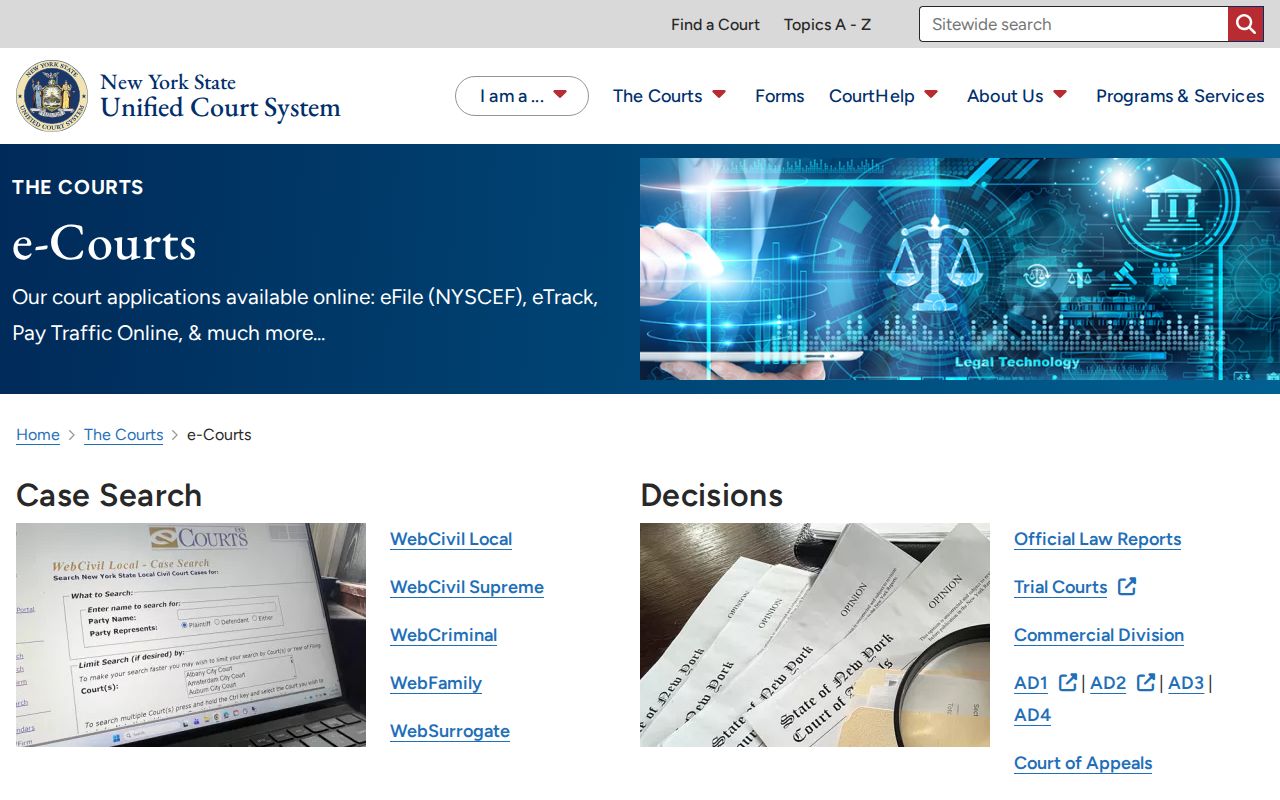
The portal family matters because each path carries different fields and different time limits. Note the exact path used, plus any case or index number that appears.
Note: A statewide criminal-history search is a separate exact-name and date-of-birth product, not a substitute for a docket search.
Matching a Jamestown Name to a Parcel
When a name connects to a Jamestown address, open the Chautauqua County Parcel Viewer to find the address point and parcel. Then record the SWIS and tax-map identifier. Searches run by address, tax ID, or owner name. Parcel actions lead to tax information, ownership history, and property details. PHD adds tax-map, deed, owner, address, sales, and old or new number search modes. Results over 100 entries should be narrowed by municipality, street, date, or tax map.
Field labels deserve attention. The 2025 Jamestown assessment-roll sample lists property location and class, current owner, and owner mailing address. It also covers school district, assessment values, parcel size or grid, account number, and deed-book reference. One sample row shows a Jamestown situs for 236 Fluvanna Avenue. It lists a Phoenix mailing address. That gap is why an owner field is a lead, not proof that a named person lives at the property.
| Sample parcel field | How it helps a resident lookup |
|---|---|
| Tax map and SWIS | Stable joins between the GIS, PHD, assessment roll, and deed research. |
| Property location | The situs or physical property field, distinct from a mailing location. |
| Current owner and mailing address | Tax-record information that may point to a person or entity, but does not establish occupancy. |
| Account and deed-book reference | Clues for comparing dated assessment rows with County Clerk land records. |
The county's own disclaimer labels parcel information informational. Confirm legal ownership or a boundary through the official record route. Treat a company, trust, estate, or absentee mailing recipient as no sign of a current resident.
Verify a Jamestown Resident Carefully
A careful resident lookup builds a small provenance bundle. Save the exact spelling searched. Save the address as entered, the portal, the date, and any record number. Weigh name variants instead of forcing a match. A middle initial is one fact. An older street number is another. An owner mailing address and a directory line are different facts too. The question is whether two official records describe the same person. Every record cannot be bent into an occupancy statement.
- Normalize the known name and address, keeping apartment or unit, ZIP, postal city, and claimed municipality in separate fields.
- Use the GIS and PHD to obtain the Jamestown tax-map or SWIS identifier. Record whether the name is an owner, a mailing recipient, or absent.
- Choose the eCourts portal that fits the matter, then compare a displayed party name, court, case number, and date with the other evidence.
- For an event or relationship, apply the City Clerk or state vital-record rules and request only the record type for which the requester is eligible.
- Write a source-specific negative result, such as not found in PHD or not online in eCourts, instead of saying the person does not exist.
- Docket
- A court's running case record, usually identified by a case, index, file, or summons number.
- Index and image
- An index lists a record's identifying details. An image is the underlying document when the custodian makes it available.
- Certified copy
- A copy issued and certified by its legal custodian. A search hit alone does not establish eligibility for one.
For a full address-by-address chain rather than one person, the Jamestown By Street directory follows the separate parcel and deed workflow.
Jamestown Voter Lookup Inputs
New York's Poll Site Search, Voter Registration, and Mail Ballot Tracker is an individual lookup. It is not a bulk resident index. It requires last name, first name, date of birth in MM/DD/YYYY format, county, ZIP, and address information. JavaScript and cookies must be enabled. Chautauqua appears among the county choices. The public page publishes no complete result schema. So it is not sound to assume party, status, registration date, or other fields will be visible.
| Input | Use in the official voter lookup |
|---|---|
| Last and first name | Identity fields for a useful match. |
| Date of birth | Entered as MM/DD/YYYY for the individual lookup. |
| County and ZIP | Context fields that include Chautauqua and a five-digit postal ZIP. |
| Address information | Required by the portal instruction before searching. |
Election records in Jamestown move through a formal request path. The State Board of Elections handles them under its FOIL process, and the requester must state an election purpose, a requirement set by Election Law section 3-103(5). Some registrations stay closed. Confidential status under Election Law section 5-508 shields those voters from ordinary inspection or copying, so a resident lookup built on election rolls will always have a gap. Ward names and polling places, by contrast, are simply civic geography; they describe where votes happen, not who lives on a given block.
Jamestown Vital Records as Evidence
A vital record proves an event, a place, or a family tie. The Jamestown City Clerk keeps events filed in the city. Certified birth copies go only to the named person or a parent with proper identification. Death-copy requests require the qualifying relationship or legitimate-purpose proof the city specifies. Marriage records stay with the issuing clerk. Birth and death copies cost $30 each, and a city marriage copy costs $10.
Genealogy copies follow a separate route. The city and New York State use broad thresholds. Births open at 75 years. Deaths and marriages open at 50 years. Listed conditions apply to the death and marriage copies. A direct-descendant exception applies once relationship is proved. The state route covers New York outside New York City from 1881. It warns of significant processing delays. A genealogy threshold never turns a certified record into an open resident record.
Read the Jamestown vital-record instructions before filing a request.
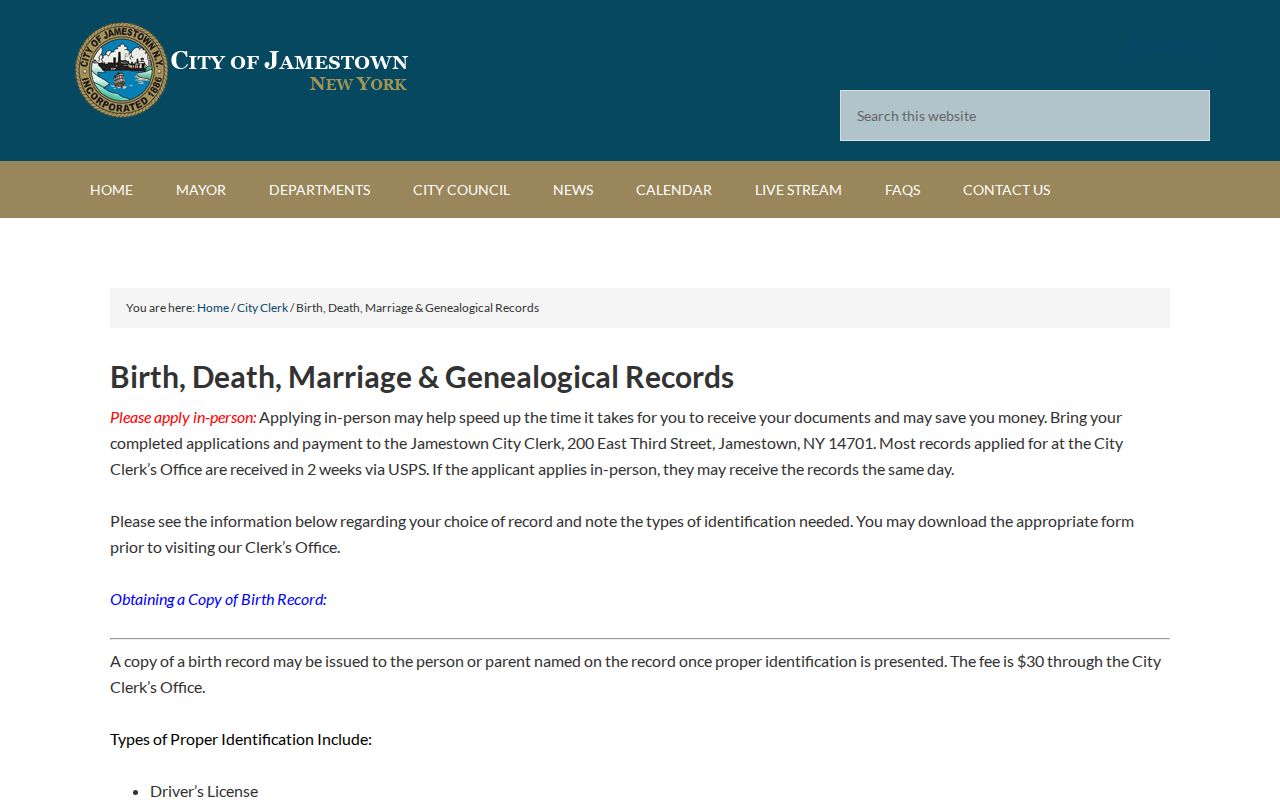
The clerk's instructions break requests into four parts: event type, eligibility, identification, and the genealogy route. Matching the event to the right municipality prevents a local request for a state-held record.
Jamestown Resident Lookup in Dated Directories
Prendergast Library holds Jamestown city directories from 1875 forward. The set runs to the current year and adds newspapers, census material, and church and cemetery microfilm. Coverage reaches beyond the city limits. The digitized 1892-93, 1898-99, and 1899-1900 volumes include street and map material. A directory ties a surname to a time. Nearby places appear in them too: the 1892-93 book includes Falconer and Lakewood. The 1898-99 edition adds Celoron.
Read the street section and its abbreviations first. The 1899-1900 book follows a “street implied” convention, so a printed line may lack a full modern-style address. Treat each volume as a dated snapshot. Check the place, the volume date, an address source, and, where needed, the custodian record. Common surnames make that discipline matter even more.
Note: Keep the printed address and the current matched address as separate fields whenever a historical directory is part of the search.
New York FOIL for Missing Records
Ask the office that holds the record. New York's Freedom of Information Law is the tool. It sits in Public Officers Law Article 6, mainly sections 87 and 89. A reasonably described request goes to the agency records-access officer. State Open Government guidance calls for a written response within five business days. The response has a few forms. It grants the request. It denies the request with reasons. It reports no record located after a diligent search. It may also acknowledge receipt with an approximate date. Appeals are due within 30 days. The appeal response is due within ten business days.
In Jamestown, the City Clerk or Treasurer serves as Records Access Officer. The authority sits under City Code section 220. Older county court or land material may require the County Clerk's counter. It may also require public computers or staff assistance. FOIL paper-copy limits and the County Clerk land-copy charge are separate fee rules. Name the record type and date range. Add the person or parcel identifier and say whether a certified copy is needed. That yields a search, not a person profile. A specific ask serves everyone better than a broad profile of a person.
Privacy Limits for Jamestown Residents
New York access has firm limits. The Address Confidentiality Program, under Executive Law section 108, gives eligible participants a substitute mailing address. Their actual address stays confidential. Confidential voter registration under Election Law section 5-508 is maintained separately and kept from ordinary public inspection. Court portals can exclude sealed or restricted cases. Vital records carry eligibility rules. DMV personal information, including full date of birth, phone, identification, and medical details, has separate restrictions.
Keep any resident lookup to the minimum necessary public facts. Never copy full dates of birth, Social Security numbers, phone numbers, confidential addresses, medical information, or protected voter data into a record file. An incorrect official field needs the custodian. Contact that office and follow its correction process. A FOIL request can obtain existing agency records, but no agency has to create a new one.
Lawful use. Use Jamestown records for personal, lawful research and respect restricted information. Using record fragments to stalk, harass, or intimidate someone can violate New York law.