
Jamestown City Directory Collections
Prendergast Library’s genealogy guide lists a long local run, from 1875 to current volumes, under call number R 917.479 J. That listing is the best located guide to the shelf, but it does not promise that every individual year is available or circulating. The strongest approach is to identify the year needed, ask the library to confirm it, and record the volume and page with every finding. Fenton History Center adds a separate local-history setting with directories, family files, maps, yearbooks, cemetery material, and local histories. Together, these holdings give a household trail far richer than an undated name search.
| Collection | Years | Where held | Access |
|---|---|---|---|
| Jamestown directory run, R 917.479 J | 1875 to current, as listed | Prendergast Library | Confirm the individual volume before visiting |
| White and White Brothers volumes | 1892–93; 1898–99 | Prendergast digital files and local collections | Digitized copies were identified |
| Journal Printing Co. volume | 1899–1900 | Prendergast digital file and local collections | Alphabetical and street material |
| NY Heritage directory items | 1909; 1966 | SUNY Fredonia Special Collections & Archives / NY Heritage | Digitized browse and download |
| Fenton local-history sources | Catalog and local collections | Hall House Research Center | Appointment and research-request options |
The runs are not a continuous modern roster. Each volume reflects its publisher’s time, scope, and conventions. The 1892–93 book includes Falconer and Lakewood, while the 1898–99 volume includes Falconer, Lakewood, and Celoron. A Jamestown label in one of those books therefore identifies a publication area, not a final ruling on municipal residence.
Jamestown Directory Years at Prendergast
The Prendergast Library genealogy guide puts the directory run beside newspaper microfilm, selected census materials, church and cemetery records, clippings, atlases, and county histories. That arrangement matters when a name vanishes from one annual book. The Jamestown Journal is listed from 1826 to 1881, followed by the Evening Journal through September 1941, the Morning Post from 1915 to 1941, and the Post-Journal from October 1941 to current. The guide also identifies marriage and death clippings, so an address change can be checked against an event notice rather than guessed at.
Start with the book closest to a known date. Search initials as well as full names, and note spelling variants before deciding that a household is absent. The same volume’s street section, map, wards, and election districts can help distinguish two similar names. If a record will be used for an estate, vital, or land question, take the directory finding to the appropriate custodian. A directory line cannot replace a certified record, deed, or court file.
Note: The guide gives a holdings range, not a complete year-by-year inventory, so confirm the actual volume with Prendergast before relying on an in-person trip.
Jamestown Family Files at Hall House
The Fenton History Center research page describes the Hall House Research Center at 73 Forest Avenue as an appointment-based place to work with local directories, family files, maps, school yearbooks, cemetery books and microfilm, Chautauqua histories, and Swedish-American genealogy newsletters. It generally lists Monday, Thursday, Friday, and Saturday appointments from 10 to 4, and asks researchers to call 716-664-6256 ahead. Its online catalog has more than 7,000 volumes and expands weekly. Staff can pull references and can handle mail or email research requests, with a fee for extensive work.
A screenshot of the Hall House research access page shows the kind of local-source inventory available before an appointment.
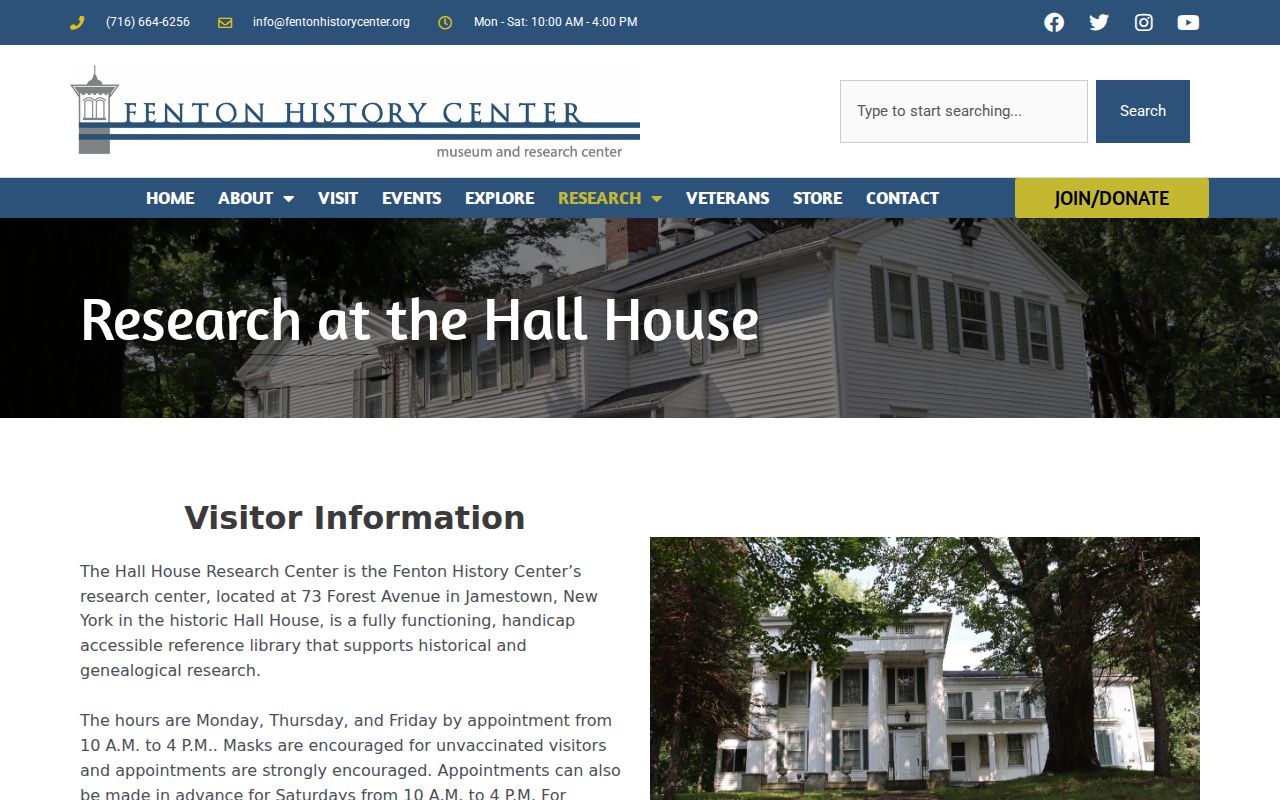
Fenton is especially useful after a directory provides a name and date but leaves a relationship, school, cemetery, or neighborhood question unresolved. Its materials are research aids, so preserve the collection name and a source date with any notes.
Jamestown Directories in Digital Collections
Several digitized books make it possible to inspect the format before requesting a physical volume. The 1892–93 publication credits F.H. & W.A. White and includes city government, wards, election districts, a street and avenue directory, alphabetical names, a classified business section, and a map. The 1898–99 White Brothers volume adds a street, avenue, and alley section as well as a separate group for people receiving mail at the Jamestown post office. The 1899–1900 Journal Printing Co. volume describes alphabetical, household-street, civic, and classified material.
The NY Heritage Chautauqua County directories collection adds two distinct items: a 1909 Swedish-language directory and a 1966 tourist pocket guide with a pull-out map and streetcar lines. The originals are associated with SUNY Fredonia Special Collections & Archives. Those items show that local directory research can preserve language and travel context as well as names and addresses.
The NY Heritage collection page identifies the digitized directory material available through its Chautauqua holdings.
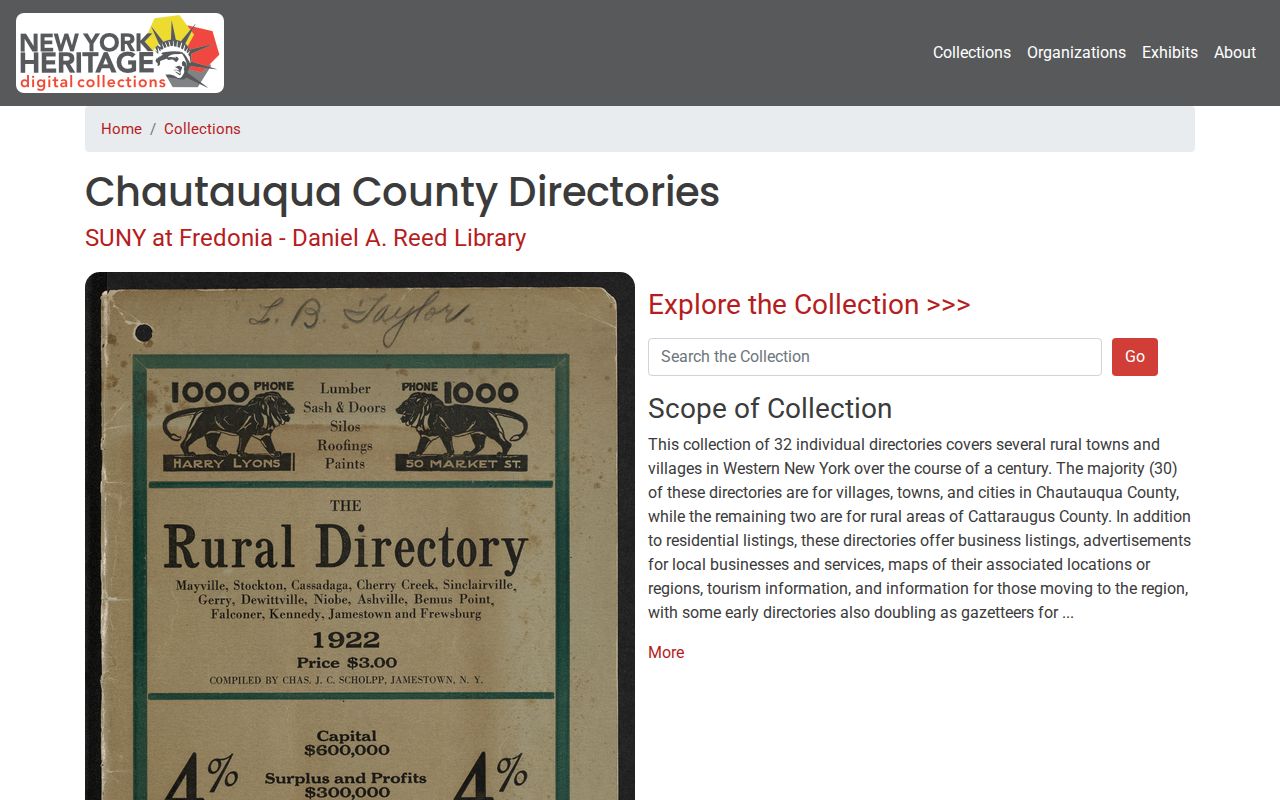
Digital images make inspection easier, but page images still need careful transcription. Keep the printed name, the page or image number, and the exact wording rather than silently modernizing every field.
Reading a Jamestown City Directory Entry
A 1899–1900 sample shows why each part of a printed line deserves its own note: “Flanders, Benjamin E. (Nellie M.), machinist, house 148 Jones & Gifford ave.” It gives a surname and given names, a spouse in parentheses, an occupation, and a printed residence line. It does not establish current occupancy, ownership, or a legal address. Record the printed text first, then compare it with the same book’s street section and map. The 1899–1900 volume also supplies an abbreviation key, including directions such as N, S, E, and W, plus terms such as res, rms, ry, and P.O.
| Personal name | Transcribe surname, given names, initials, and spelling as printed. |
|---|---|
| Household clue | A spouse may appear in parentheses, but the line does not prove every household member. |
| Occupation | Capture the activity exactly; it is a dated description, not current status. |
| Residence line | Keep the house number, street wording, and page with the source year. |
| Street section | Use it to test the printed address against nearby household listings in that volume. |
- Criss-cross directory
- A reverse arrangement that lists households or addresses in street order. The identified Jamestown books have street sections; no separate current reverse run was verified.
- Householder index
- An alphabetical arrangement intended to lead from a person or household name to a printed listing.
- Abbreviation key
- The volume’s own list of shortened terms. Read it before expanding a word or direction in a transcription.
- Street implied
- A 1899–1900 convention in which the preceding street context can carry into a line, making a modern-looking complete address an unsafe assumption.
Keep the surname, spouse clue, occupation, printed address, page, and source year as separate notes. That small discipline makes it possible to revisit a disputed transcription and prevents a later researcher from mistaking a normalized address for the language in the book.
Jamestown Directory Areas Need Checking
Old publication geography can cross the same kinds of lines that complicate a modern postal address. The 1892–93 book includes Falconer and Lakewood, and the 1898–99 book includes Falconer, Lakewood, and Celoron. The latter also contains a separate section for people residing near, and receiving mail at, the Jamestown post office. That postal connection is useful historical evidence, but it is not a city-limit finding.
For a modern match, keep the historical address as printed and the current matched address as separate fields. Compare the old map and street section with a municipality layer, a parcel tax-map number, and deed evidence where needed. The current six municipal wards, old directory election districts, and county poll-site groupings are different civic layers. Each needs its own source year.
Trace Jamestown Households Through Directories
Use annual volumes to build a careful sequence, not a single dramatic conclusion. A first appearance may reflect a move, a new listing practice, or a spelling change. A disappearance may reflect a move, death, omission, or altered household wording. Pair the local books with the selected 1860, 1865, 1870, and 1875 census information and U.S. Chautauqua schedules on microfilm that Prendergast lists, then use later federal census material as lawfully available. Newspapers, probate, vital records, and deeds can settle questions that a directory leaves open.
- Choose a volume close to a known event and save the exact page, printed line, and publication year.
- Search the name forward and backward with initials, middle names, and likely spelling variants.
- Check the same volume’s street section and map before treating a number as a modern location.
- Pair the directory sequence with an available census year, then compare relationships, age ranges, and address clues.
- Use an obituary, deed, probate file, or vital-record path to corroborate a move, death, or family connection.
When a historical entry needs a modern record check, the Jamestown resident lookup route separates current official systems from historical leads. For current parcel and address research, use the Jamestown by-street directory rather than treating a nineteenth-century listing as current evidence.
Jamestown Directory Shelf Timeline
The local shelf fits within a longer record history. Chautauqua County genealogy holdings begin with land deeds and mortgages in 1811, while the Prendergast guide lists the local directory run from 1875. City historical-marker material places Jamestown’s incorporation on March 31, 1886. These dates help set expectations: a house may predate the city, a directory may follow it, and a deed trail may start earlier than a name listing.
- 1811: County deed and mortgage holdings begin.
- 1875: Prendergast lists the start of the local directory run.
- 1886: Jamestown was incorporated as a city on March 31.
- 1892–1900: Identified digitized books show White, White Brothers, and Journal Printing Co. formats.
- 1909 and 1966: NY Heritage identifies a Swedish-language directory and a tourist pocket guide.
The Library of Congress also identifies a March 1886 Jamestown Sanborn set with 15 sheets. It can show building and street context for an address, but it is not a list of people. Keep a map finding beside its sheet and date, then use a directory or other source to identify a household.
Jamestown Newspaper and Map Context
The Jamestown Community History Archives offers digitized newspaper research material, while the local library guide identifies microfilm and clipping holdings. A dated obituary, marriage notice, or legal notice may supply a relationship or precise event date that an annual book cannot. Historical content may use language that does not fit modern use, and a newspaper finding still needs corroboration when a certified record matters.
For an address that seems to have changed, use the 1886 Sanborn sheets for built-environment context and then test the location through maps, parcel sources, and deeds. No official citywide renumbering or street-name crosswalk was located in the research. That gap is a reason to preserve uncertainty, not to force an old house number into a current parcel.
Note: Preserve the volume, page, printed address, and source date together so another researcher can repeat the historical match without relying on memory.