
Finding Jamestown Residents
No official master list names everyone in Jamestown. The right record depends on the question. An address points first to the county parcel systems, where the situs, tax map, owner field, and deed reference can be kept separate. A name may instead need the New York voter lookup, the correct eCourts path, a City Clerk event record, or an old printed directory. The strongest result is a bundle of dated records, not one name hit.
Property ownership is not the same as occupancy. A mailing address can belong to an owner far from the parcel, and an old directory line captures only the year printed. The voter tool is an individual, input-gated service rather than a public bulk roll. Those distinctions keep a Jamestown residents directory search tied to what each custodian actually records.
- Enter the exact address in county GIS and the Parcel History Database. Preserve the municipality, SWIS code, tax-map number, situs, and mailing fields.
- Use that parcel key to inspect a dated assessment roll and the linked tax, ownership-history, or property-detail records.
- For an eligible name-based question, use the New York voter tool with its required identity and address inputs.
- When title matters, check the County Clerk deed path and its older/newer SearchIQS book split.
- For a past household, pair the exact directory line with its street section, another year, a parcel or deed, and a dated newspaper or census lead.
Note: A source-specific “not found” result is useful evidence, but it never proves that a person does not exist or does not live in Jamestown.
Jamestown Records Offices
Jamestown keeps municipal files close to home, while land and many court records sit with Chautauqua County in Mayville. The City Clerk routes city vital, permit, council, and FOIL matters. The County Clerk keeps land instruments, court papers, business certificates, and historical material. County parcel tools form the practical link between a Jamestown address and the land-record system. For a full address chain, use the Jamestown by-street directory.
The County Clerk office page explains the county channel behind land, court, and genealogy research. It is also the start for copy requests, public computer access, and historical holdings that do not appear in a web search.
The County Clerk page documents the office behind this record path.
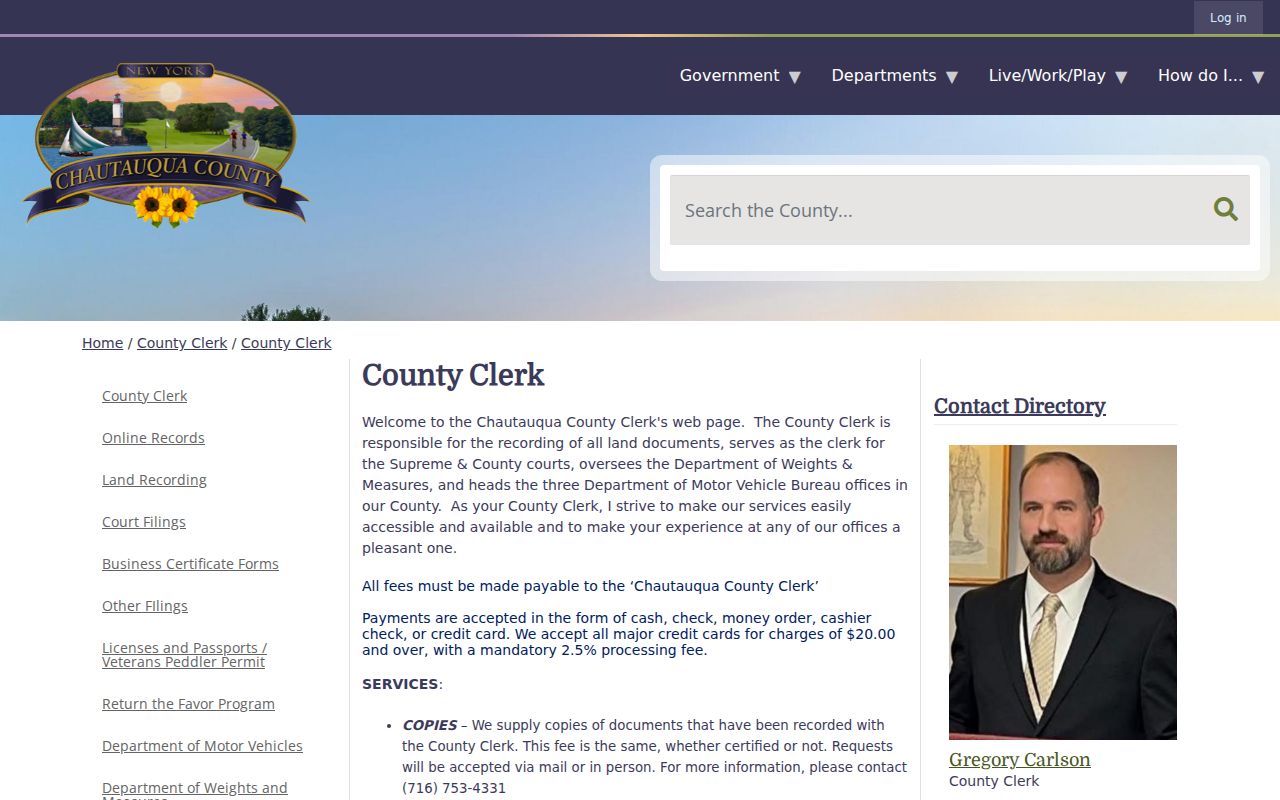
That County Clerk record page identifies the county channel behind land, court, and genealogy research, rather than treating a city address as a city-only record.
Jamestown Parcel Search Fields
The County Parcel History Database is the most flexible first stop for a Jamestown address. It has separate paths for a tax map, deed information, owner name, address, and sales. Its old-number and new-number choices matter when a parcel identifier has changed. The portal labels its data informational and says it updates weekly, so a current legal boundary or ownership question still belongs with the official county record.
| Field or control | Type | Use in Jamestown | Portal note |
|---|---|---|---|
| SWIS / Municipality | Selector | Sets municipal context | Use with a tax-map search |
| Tax Map # | Text | Matches a parcel identifier | Partial examples are shown |
| New Number / Old Number | Choice | Bridges changed identifiers | Useful for a historical parcel |
| Owner Name / Address | Text | Finds an indexed record trail | Does not establish occupancy |
| Exact Match / Top 100 | Controls | Narrows the display | Search Results button submits |
From a matching result, follow the current GIS, printable report, tax-card, ownership-history, and property-detail links as separate evidence paths. A parcel can hold a tax fact, an owner field, and a historical deed clue without any one of them answering who is living there today. The assessment-roll snapshot also labels current owner and current owner address as tax fields, not a resident roll.
Jamestown Voter Lookup Inputs
New York's Poll Site Search, Voter Registration, and Mail Ballot Tracker is an individual lookup, not a public roster. It asks for last name, first name, date of birth in MM/DD/YYYY format, county, ZIP code, and address information, then requires JavaScript and cookies. Chautauqua is the county choice for a Jamestown search. The reviewed page did not expose a full result schema, so it would be wrong to promise fields it does not display.
Election geography has its own labels. Jamestown's six wards are College I, Lakeview II, Chadakoin III, Bergman Park IV, Forest V, and Willard Heights VI. A ward, election district, postal city, ZIP code, and municipal boundary are related but not interchangeable. Polling assignments can change, so use the current county list for the election date that matters.
See the state voter lookup before submitting the required fields.
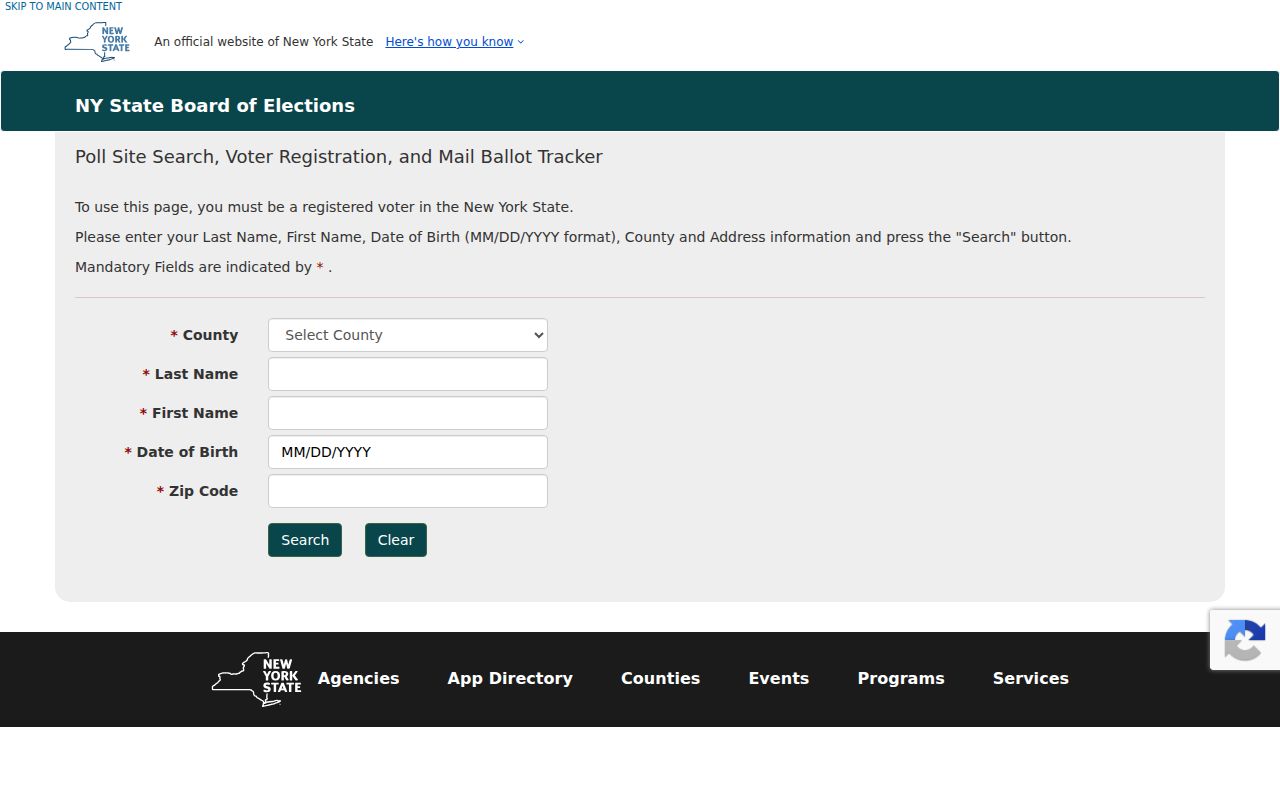
The displayed form makes the required identity and address inputs clear, while its individual-search design limits what a Jamestown resident search can establish.
Current Jamestown Resident Sources
Current-looking sources differ by purpose. The assessment roll and parcel tools are best for property facts. The voter portal can check an eligible individual's registration context. Court, license, and business searches each apply their own scope. None should be compressed into one directory entry. The table separates the question from the keeper and access route.
| Jamestown source | What it can show | Custodian | Access path |
|---|---|---|---|
| Assessment roll / PHD | Situs, owner and mailing fields, parcel key, deed clue | County parcel system | Public web and dated roll PDFs |
| GIS Parcel Viewer | Address point, parcel geometry, municipal layers | Chautauqua County | Public web |
| Voter lookup | Eligible individual's lookup context | New York elections | Required identity and address inputs |
| eCourts | Portal-specific party and case information | New York courts | Correct court search path |
| City directories | Dated name, household, and address clues | Prendergast and Fenton | Collection, scan, or research visit |
An official record preserves the field labels, date, and custodian needed to check a result. Start there when a record matters, and use the Jamestown resident lookup path when the task is confirming one person across sources. The commercial name-search category can be broad, but it does not replace a custodian's original document or an accurate access rule.
Jamestown Municipal File Trails
Municipal files add a different layer to a Jamestown residents directory search. The City Clerk handles city vital records, council material, licenses and permits, and acts as the City's Records Access Officer. Code Enforcement records begin with a complaint, officer investigation, photographs or documentation, and may lead to a notice or appearance ticket. That trail can date a municipal action at an address, but it is not a title record and does not identify an occupant.
Start at the City Clerk when the record is tied to a city event or request. The Clerk is in the Municipal Building at 200 E Third Street, first floor, and lists weekday hours of 9:00 to 4:30. The city contact directory separately lists the assessor and development contacts. For a county land document, move to the County Clerk rather than asking the city to certify a deed.
The Jamestown City Clerk page identifies the municipal office and its service links.
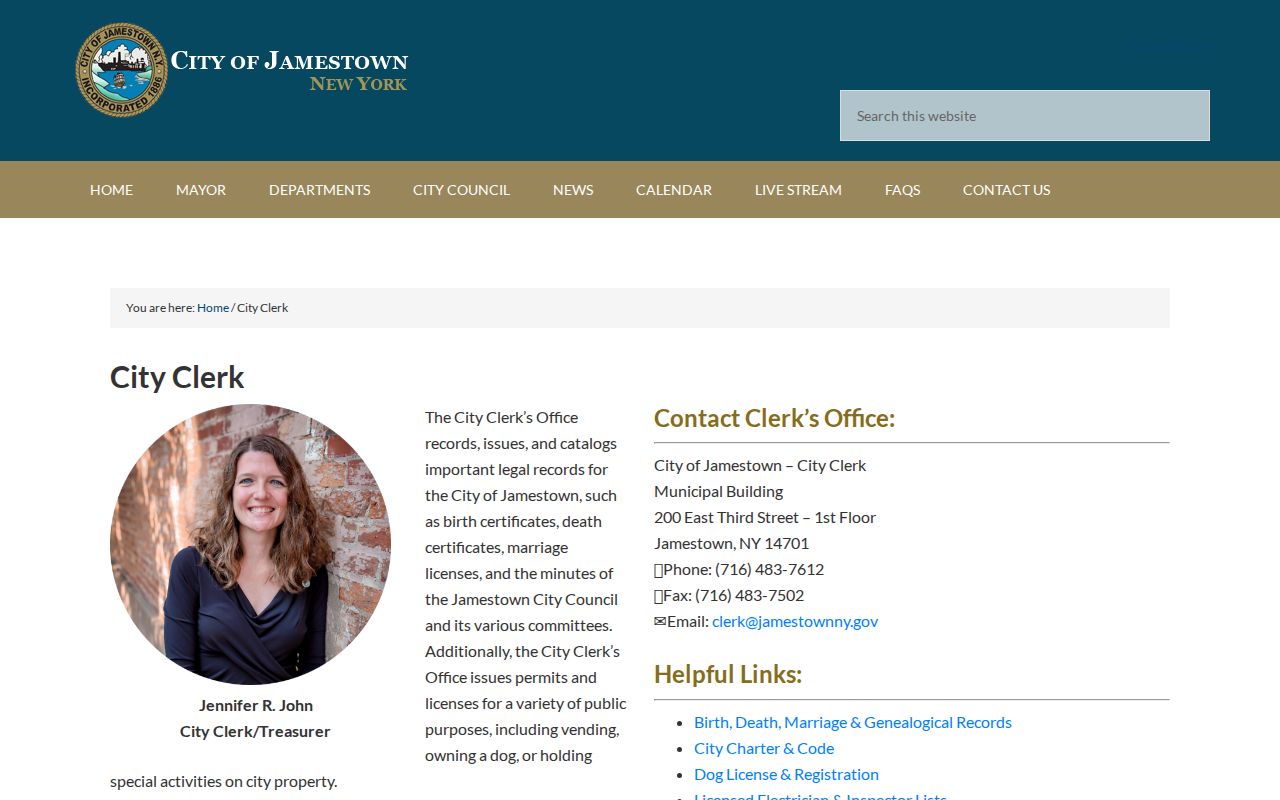
The City Clerk screen is a reminder that vital, permit, licensing, and city-request channels sit apart from Chautauqua County land records.
Jamestown Code Enforcement describes the documented complaint and notice process for an address-based municipal file.
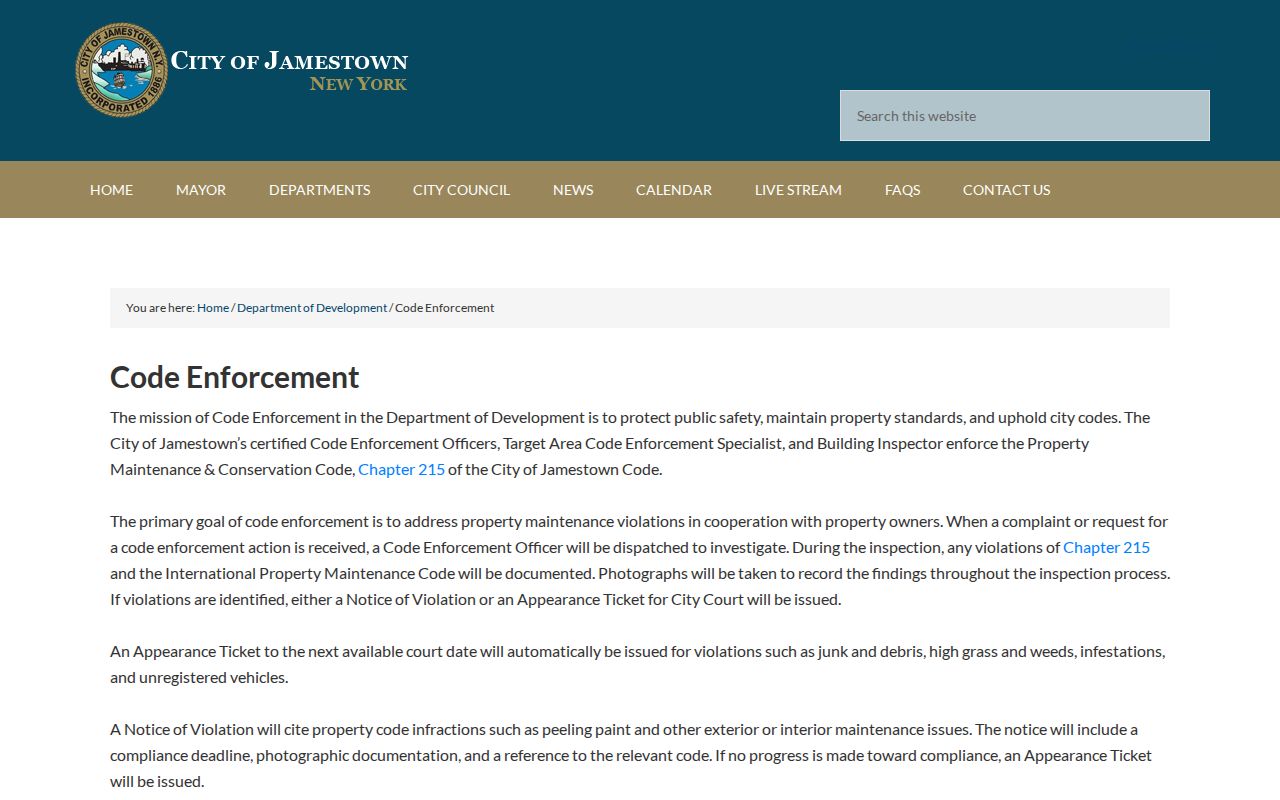
The city process shown here documents an investigation and notice path, not a list of people at an address.
Jamestown Vital Record Gates
Vital records confirm events and relationships under rules tighter than ordinary municipal files. The City Clerk handles a birth when the named person or parent has proper identification, and its death route requires a qualifying relationship or legitimate-purpose proof. A marriage certificate is tied to the clerk where the license was issued. City fees listed in the research are $30 for birth and death, $10 for marriage, and $22 for a genealogy search or no-record notice.
For older family research, the city and New York State routes use the same broad age framework: 75 years for a birth where the person is known deceased, 50 years for a death, and 50 years for a marriage where both spouses are known deceased. Direct descendants can seek a time-period waiver with proof. State processing may run eight months or longer, while the local path may be faster when the event municipality is known.
Use the City Clerk vital-record instructions for a current form and submission method.
Jamestown FOIL Access Limits
When a record is not online, New York Freedom of Information Law offers a written-request route, not a promise that every field is open. Public Officers Law Article 6, especially sections 87 and 89, calls for an agency response within five business days by granting, denying, or acknowledging a reasonably described request. A denial can be appealed within 30 days, and the appeal response is due within 10 business days. The general paper-copy ceiling is $0.25 per page up to 9 by 14 inches unless another statute controls.
Election data has a more specific rule. The State Board of Elections says a voter-data request needs an election-purpose statement under Election Law section 3-103(5). Confidential voter registration under section 5-508 is held apart from ordinary public inspection. The Address Confidentiality Program, sealed court rules, and statutory vital limits are hard boundaries, not missing search results to work around.
New York's FOIL guidance explains the request, response, and appeal framework.
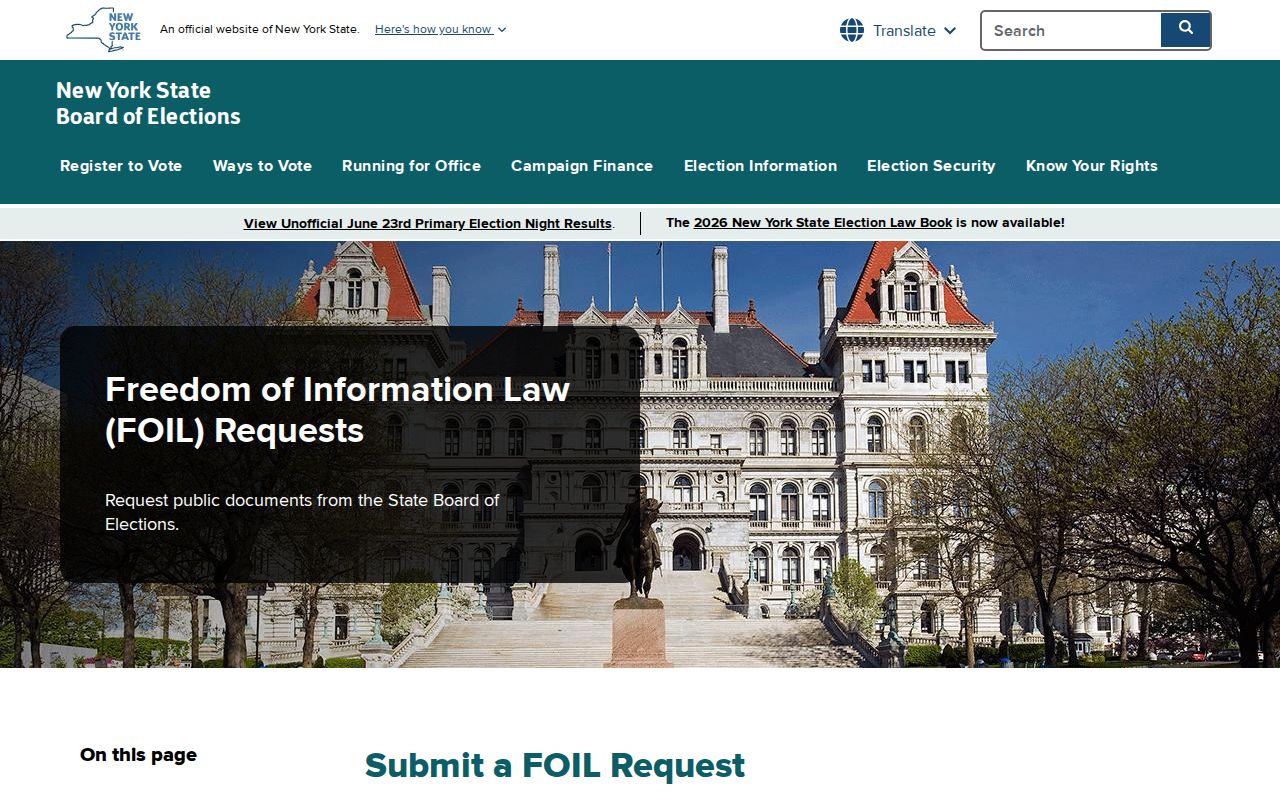
The election FOIL page is useful for the request route and purpose statement, but it does not turn the voter portal into an unrestricted directory.
Jamestown Wards and Poll Sites
Ward names add useful civic context but should not be treated as resident lists. The city map supplies six current ward labels, and the county poll-site list groups election districts at specific polling places. Both can help identify the right public agency or geographic layer. Neither proves a person lives at an address, and a poll-site assignment must be checked for the relevant election.
Postal labels need the same care. A Jamestown postal string may appear on addresses in nearby municipalities, so a ZIP code cannot settle whether a parcel lies within the City of Jamestown. The county GIS municipal-boundary layer, parcel SWIS, and assessment roll are better tests. Keep ZIP, ward, election district, municipality, and tax map as separate fields.
Chautauqua County poll-site locations provide the current election-district reference.
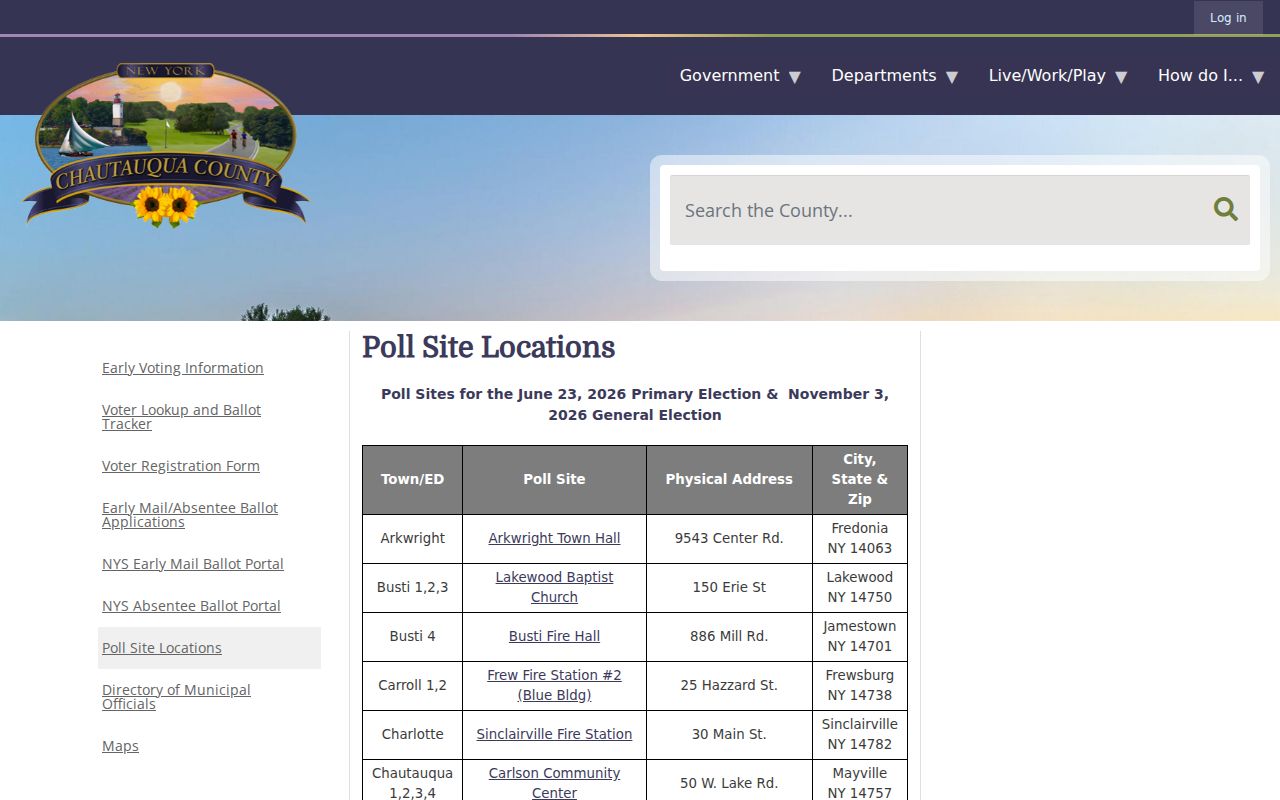
The county listing shows why a ward, an election district, and a postal city must remain distinct labels in a Jamestown search.
Jamestown Court and Custody Checks
A court party search answers a court question, not a residency question. New York's eCourts hub links to separate WebCivil Local, WebCivil Supreme, WebCriminal, WebFamily, and WebSurrogate paths. Jamestown City Court sits at 200 E 3rd Street, while County and Supreme Court matters have Mayville channels. Older Chautauqua court material may require Clerk staff or archival access. Use the case type, court, and date range before searching a party name.
State custody and registry searches have their own limits. The New York DOCCS lookup uses a DIN most directly, with name plus birth information as another route. It can return current or former state-incarcerated people, not a current address confirmation. The DCJS public registry has level-based display rules. A public county jail roster was not located in the reviewed official sources.
The New York DOCCS lookup explains the available identifier and name-search path.
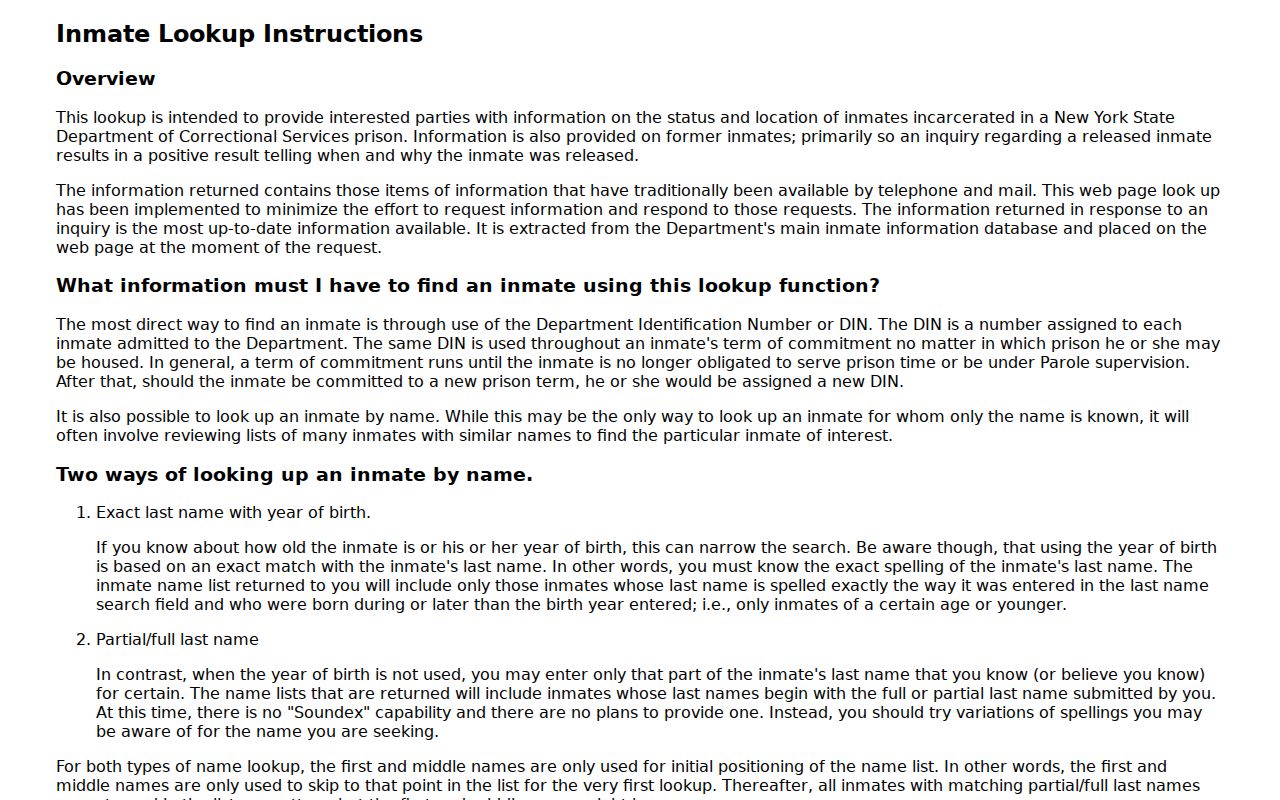
The state display supports a custody query within its stated scope. It should never be read as proof of a Jamestown residence.
Historic Jamestown Directories
For a past household, the local shelf is unusually deep. Prendergast Library lists Jamestown city directories from 1875 to current under R 917.479 J, plus newspaper, census, church, cemetery, and local-history material. The digitized 1892-93, 1898-99, and 1899-1900 books include names, addresses, street sections, maps, wards, and abbreviations. NY Heritage adds a 1909 Swedish-language directory and a 1966 tourist pocket guide.
A directory entry is a dated publication snapshot. The 1899-1900 volume can give a surname, given name, spouse in parentheses, printed occupation, and house line. Record its year, page, exact printed line, and street-section context. Then compare another year, a parcel or deed, a census source, or a newspaper notice. The deeper collection work belongs with the Jamestown city directories.
- Assessment roll
- A dated tax record that labels a parcel, owner, mailing address, and value fields. It is not an occupancy list.
- Index
- A finding tool that points to a record or book. It may not include the full image or file.
- Criss-cross directory
- An address-oriented arrangement used to work from a house or street toward a printed household entry.
- Parcel
- A tax-map unit of land. Its situs address, owner, mailing field, and legal description can be different facts.
Jamestown Land Records Evolve
Chautauqua County land records reach back to 1811, but the online path is not one uninterrupted search. Deed books 1 through 1822 cover June 25, 1811 through January 31, 1979 in Index Books; book 1823 and later begins February 1, 1979 in the Solution application. Mortgage coverage is divided in the same era. A missing result in one interface should send the researcher to the other interface, the County Clerk public computer, or a clerk request.
The county's 2025 ARPA report describes digitization of deeds and related surveys, with more than 800,000 target images and about 5,000 still under review or enhancement at that report stage. A later capital report identifies additional bound-book and trifold work. Those initiatives improve access, but an image advertised as planned or under review is not the same as a completed public record.
The County ARPA report supplies the stated digitization scope and reviewed-image caution. County deed digitization and city code records are separate Jamestown record trails, and each must retain its own source, date, and access status.
Note: Record grantor, grantee, instrument type, recording date, book or page, legal description, tax map, and image status separately when following a Jamestown land trail.
Dating Jamestown Search Results
Dates make a Jamestown residents directory result usable. The 2025 tentative assessment roll is a July 1, 2024 valuation and March 1, 2025 taxable-status snapshot. A directory year is a publication snapshot. A GIS view shows current map layers, while a 15-sheet 1886 Sanborn set records a historic built environment. Court, voter, license, custody, and registry results also have portal-specific currentness. Add the source date before comparing any two records.
Use the strongest identifier for the record type: SWIS plus tax map for property, a docket or file number for court material, event municipality and date for vital research, and a DIN or registry number where the official system provides one. If the labels conflict, preserve the conflict rather than forcing a match. That protects the person named in a record and the reader trying to understand Jamestown's changing paper and digital trails.